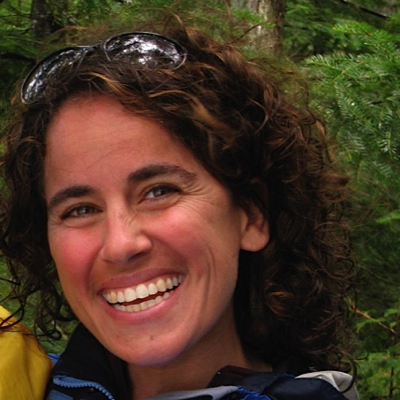
Gail Whiteman, Professor at Rotterdam School of Management, Erasmus University, appointed Professor-in-Residence at WBCSD, April 16, 2012   

Gail's appointment at WBCSD follows on the heels of her joining the Resilience Alliance recently as part of the Dutch node that also includes Professor Marten Scheffer at Wageningen University.  Gail's expertise in corporate sustainability and resilience thinking makes her ideally suited to provide academic advice and inform priorities at WBCSD.


Learning how to change in order not to change: Lessons from ecology for an uncertain world.  Dr. Brian Walker delivered the annual Krebs 2012 lecture recently at the Institute for Applied Ecology, University of Canberra.  View his lecture online


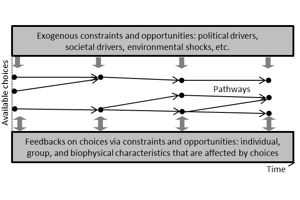
Resilience Alliance Members co-author 3 new papers produced for the Stockholm Nobel Laureate Symposium on Global Sustainability, recently published in AMBIOWestley et al. "Tipping Toward Sustainability: Emerging Pathways of Transformation", Steffen et al. "The Anthropocene: From Global Change to Planetary Stewardship", Folke et al. "Reconnecting to the Biosphere".


cover Applying a Social-ecological Inventory Workbook.  Written to supplement the resilience assessment practitioners workbook, "Applying a Social-ecological Inventory" describes in detail a pre-assessment method to help with identifying existing knowledge and activities already underway in a region, as well as the key actors involved with regards to a particular issue.

Visit resilience assessment to download this and other workbook files and to browse resilience assessment online resources.


Resilience Assessment Workbook for Practitioners Version 2.0.  A fully revised workbook complete with new examples, updated framework, and an expanded section on synthesizing the assessment findings provides an alternative way of thinking about and practicing natural resource management. 

Visit resilience assessment to download the workbook and browse new online resources including examples of key concept applications, an annotated bibliography, and an open database of resilience assessment projects.


E & S Feature Article: Planetary Boundaries: Exploring the Safe Operating Space for Humanity addresses resilience at the global level for the first time.  Rockström introduces Planetary Boundaries in a whiteboard seminar: "These scientists propose that so far there are only 9 identifiable processes in the Earth system that have clear risk of causing disastrous or unacceptable, large threshold effects if we cross beyond safe boundaries."  A condensed version of the article published in Nature includes links to follow-up commentaries.


BOOKS (& more books)


Collaborative Resilience: Moving Through Crisis to Opportunity  

Edited by Bruce Goldstein (2011).  Contributors examine efforts to collaborate after natural disaster, technological failure, economic collapse, or acts of violence, and describe how communities have survived and even thrived by building trust and interdependence. Cases include environmental assessment in Cozumel, Mexico, governance of the Montana's Blackfoot Valley, fisheries management in Southeast Asia's Mekong region; and restoration of fire regimes in the U.S. Visit the author's website.   


Social Network Analysis: A quantitative approach to the study of social relations  

In this book, edited by Orjan Bodin and Cristina Prell (2011), the use of the SNA in studying natural resource management is explored. The authors show how the relational approach provides the means to uncover and analyze the complex patterns of interactions among actors that characterize most real-world governance settings and how this can be used to explain various governance outcomes. The book is available here on the Cambridge University Press website.


Spatial Resilience in Social-Ecological Systems  By Graeme Cumming (2011). The first book to comprehensively cover the influence of spatial variation on the resilience of social-ecological systems.  From the publisher's website "This book will become a shining star, a classic in the explosion of new ideas and approaches to studying and understanding social-ecological systems" Carl Folke, Science Director of the Stockholm Resilience and Director of the Beijer Institute of Ecological Economics.


Foundations of Ecological Governance Edited by Lance Gunderson, Craig Allen, and C.S. Buzz Holling (2010). From the publisher's website "Foundations of Ecological Resilience is a collection of the most important articles on the subject of ecological resilience - those writings that have defined and developed basic concepts in the field and help explain its importance and meaning for scientists and researchers."


Principles of Ecosystem Stewardship: Resilience-Based Natural Resource Management in a Changing World. The first textbook to take a resilience-based approach to natural resource management is now available from the publisher’s website. Written for students, researchers, and practitioners, the textbook links current research with practical applications for managing ecosystems in times of change and uncertainty. Edited by Resilience Alliance members Stuart F. Chapin, Gary Kofinas, and Carl Folke.


Resilience Thinking A book by CSIRO scientist and RA Program Director Brian Walker and science writer David Salt provides an accessible introduction to resilience research and argues for a dramatic change in how natural resources are managed. The resilience framework is explored by way of five case studies that demonstrate how communities are better able to withstand cycles of change when ecological drivers are better understood and when natural change is embraced rather than controlled. Copies of the book can be ordered online from Island Press


RA RESOURCES

Resilience Assessment Workbooks - The RA has developed two workbooks for assessing resilience in social-ecological systems - one for natural resource managers and practitioners and a second for research scientists. Both employ strategic questions and activities designed to explore system parameters and management options for social-ecological systems from a resilience perspective.


Join the RA's researcher database, submit your own profile, and search the database to find others working in your field. Anyone may submit their information for review and inclusion in the database. Database fields include: name, institution, position, country, geographic area of research, keywords, brief summary of research interests, and contact information.


Join the RA's email group for graduate students and post-docs doing resilience-related research. The email group is open to all graduate students/post-docs who are interested in discussing resilience research and sharing information on events, conferences, literature, etc. Read More.


A history of bicycle transformation in the Netherlands
2012/04/26
Political Ecology and Resilience
2012/04/22
Robert Harrison on Joesph Conrad
2012/04/21
Impacts of Geoengineering on Biodiversity
2012/04/10
Sustainability in the Anthropocene: A Techno-Political Project (not a Scientific one)
2012/04/05
Can Geoengineering and Planetary stewardship be combined?
2012/03/30
Montpellier Panel – Growth with Resilience: Opportunities in African Agriculture
2012/03/29
Resilience Science on Twitter
2012/03/27
Planet Under Pressure: Understanding the Anthropocene
2012/03/26
Paul Gilding talks about Limits to Growth
2012/03/01
Forty years of Limits to Growth
2012/02/29
Declining child mortality – fast and slow
2012/02/29
Was this page useful to you? Very Somewhat Not really Not at all     
Page created on Mar. 14, 2001 09:37:55; Visits: 985937 (~241 per day)

Aga Khan University East Africa | ARC Center of Excellence for Coral Reef Studies | ASU Global Institute of Sustainability | Beijer Institute of Ecological Economics | Centre de Coopération Internationale en Recherche Agronomique pour le Développement (CIRAD) | CGIAR Challenge Program Climate Change Agriculture Food Security | CSIRO Sustainable Ecosystems | Emory University | Indiana University Workshop in Political Theory and Policy Analysis | McGill University Natural Resource Sciences | University of Nebraska | Simon Fraser University School of Resource and Environmental Management | Social Innovation Generation University of Waterloo | South Africa National Parks | Stockholm Environmental Institute | Stockholm Resilience Center | Tyndall Centre | University of Alaska Fairbanks


Copyright 2012 The Resilience Alliance.